
The Plug Works Fine, Until October
No, a standard indoor smart plug should not live outside. Rain is only one threat, and cold nights, condensation, and weak Wi-Fi cause failures even under a covered porch. What works is an outdoor model with a stated IP number, such as IP44 for sheltered spots or IP65 for open exposure. It also needs an in-use cover that still closes and a power-restore setting for GFCI trips.
String lights on the patio, a fountain pump, holiday decorations on a schedule. The idea is obvious and the spare indoor smart plug in the drawer looks like it would do the job.
It will, for a while. Then a storm, a cold snap, or a humid week ends it, and the failure is rarely dramatic enough to be obvious. The plug simply stops responding, or the schedule quietly stops firing.
Outdoor use puts four separate stresses on a device built for a living room, and only one of them is rain. Understanding all four is what separates an install that survives a winter from one that needs replacing twice a year.
This guide covers the ratings that mean something, the electrical-code detail that stops most installs at the wall, and which loads an outdoor plug can honestly handle.
Four Ways An Indoor Plug Dies Outside

Water gets all the attention because it is visible. The other three failures do their work slowly, which is exactly why people misdiagnose them as a bad product.
Temperature comes first. Many indoor smart plugs list an operating range that starts around freezing, and a cold night below that range can leave the radio unresponsive even after it warms up again. An outdoor model is built for a wider band, and TP-Link rates its Kasa EP40 outdoor plug from -4°F to 122°F.
Condensation follows. Warm days and cold nights drive moisture inside a sealed-looking housing, and it settles on the board rather than running off. A covered porch does nothing about this, which surprises people who assumed shelter was enough.
Signal is the third. Your router sits indoors, and 2.4GHz has to pass through an exterior wall to reach the far corner of the garden. Plugs commonly pair during setup near the door and then drop once installed where they belong.
Corrosion finishes the job. Salt air near the coast and fertiliser dust near a lawn both attack contacts, so a plug that survives the weather can still fail at the pins.
The In-Use Cover Nobody Measures

Here is the detail that stops most outdoor installs before they start. Outdoor receptacles in wet locations require a weatherproof in-use cover, the hinged bubble that closes over whatever is plugged in.
A smart plug is deeper and wider than a standard plug, so the cover frequently will not shut. People then leave it propped open, which defeats the entire purpose and exposes the receptacle to exactly the water the cover exists to stop.
Measure the inside depth of your cover before ordering anything. Three routes work: a slim outdoor plug designed to fit, a deeper replacement in-use cover, or a stake-mounted outdoor smart outlet that brings its own sealed enclosure and simply plugs in.
That third option deserves more attention than it gets. A stake unit sits in a flower bed with the receptacle enclosed, gives you two or three controlled sockets, and sidesteps the cover question completely.
Then there is the GFCI interaction. Outdoor circuits carry ground-fault protection that trips during storms and sometimes for reasons nobody identifies, and many plugs default to off when power returns instead of restoring their last state.
For a pump or a security light, that default is a real problem. Look for a power-restore or last-state setting in the specification before buying, and confirm it on the official site, as of 2026.
Matching The Plug To The Load
Outdoor loads run heavier than indoor ones, and the numbers matter more here. Our best smart plugs guide covers the general capacity maths, and the outdoor version of it is stricter. As a reference point, TP-Link lists the Kasa EP40 at a 15A maximum load in total and a maximum power of 1,875 W.
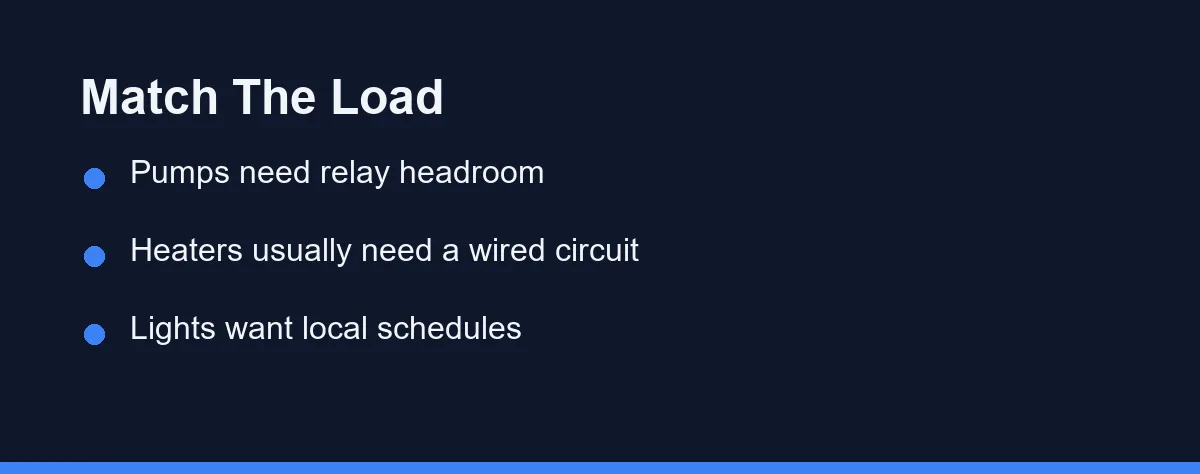
Motor loads are the main hazard. Fountain pumps, pond pumps, and compressors draw a surge at startup that runs several times their running current, and repeated surges weld a relay closed. A welded relay means a plug stuck permanently on, which nobody notices until the pump runs dry.
Heaters are the other trap. Patio heaters and de-icing cables sit near the top of what a domestic circuit tolerates, and continuous-load rules cut the usable headroom further. Most belong on a switched, wired circuit rather than on any plug.
| Outdoor use | Look for | Main risk | Verdict |
|---|---|---|---|
| String lights, covered porch | IP44 or better | Condensation over time | Straightforward, most plugs cope |
| String lights, open patio | IP65, in-use cover fits | Direct rain, cover clearance | Fine with the right body shape |
| Fountain or pond pump | IP65, motor-rated relay | Startup surge welds the relay | Check the inrush rating first |
| Patio heater | Usually not a plug job | Sustained high current | Prefer a wired switched circuit |
| Inflatable decorations | IP65, timer support | Fan motor cycling, wind | Workable, watch the duty cycle |
| Shed or garage tools | IP44 indoors, IP65 outside | Signal range, dust ingress | Add a repeater or use Zigbee |
Read the verdict column as guidance rather than permission. Local wiring rules differ by country, and anything involving a fixed heater or a pond deserves an electrician’s opinion rather than a listing’s reassurance.
Wi-Fi, Zigbee, Or Thread At The Garden Edge
Protocol choice matters more outdoors than indoors, and for a reason people rarely consider. A Wi-Fi plug is an endpoint, so it either reaches your router or it does not.
A mains-powered Zigbee or Thread plug is also a repeater. Put one near the back door and it extends the mesh toward the shed, which fixes the range problem and adds a controlled socket at the same time. Our Matter vs Zigbee guide covers how those ecosystems differ.
Schedules deserve a second look too. Sunset-based timing needs a cloud service and your location, so an internet outage can leave garden lights dark all evening. A plug that stores its schedule locally keeps running regardless.
Test the connection where the plug will actually live before you mount anything. Pairing at the kitchen table proves nothing about a corner forty feet away behind a brick wall.
Installing It So It Survives A Winter
The right plug still fails when the install invites water in. A handful of habits, all of them free, decide whether the thing lasts one season or five.
Give every cable a drip loop. Let the lead hang below the connection before it rises into the socket, so water runs off the low point instead of tracking along the cable into the housing. This single trick prevents more outdoor failures than any rating on the box.
Mount connections above ground level. Anything resting on soil or paving sits in standing water after a storm and in snowmelt all winter, and a stake unit exists precisely to lift the joint clear.
Use outdoor-rated extension leads for everything downstream. An indoor lead plugged into a beautifully sealed outdoor socket simply relocates the weak point, and the failure then looks like the plug’s fault.
Seal or cap unused sockets on a multi-outlet stake unit. Those open faces are exactly as exposed as the one you are using, and most units ship with covers that people discard with the packaging.
Orient the plug so water cannot pool on its face. A vertical body sheds rain, while a horizontal one collects it around the pins, and a small rotation at install time costs nothing.
Then walk the installation twice a year, before winter and after it. Look for a cover that no longer closes fully, a cracked housing, green corrosion on pins, and a lead that has worked loose. Five minutes in autumn is cheaper than a dead pump in January.
Who Should Buy Which Outdoor Plug
Match the plug to the job rather than to the price. These verdicts cover the situations that come up most.
Seasonal decorations on a covered porch. A basic outdoor-rated plug with a local schedule handles this comfortably. Bring it inside during the off-season and it will last years.
A pond or fountain pump running daily. Prioritise the relay rating and the power-restore behaviour over app features. A pump that fails to restart after a GFCI trip is worse than a pump with no automation at all.
Security lighting. Choose a plug that stores schedules locally and restores its last state after a power cut. Lighting that depends on a cloud service is lighting that fails on the night your internet does.
A shed or garage at the end of the garden. Solve the signal problem first with a mesh protocol or a repeater. No amount of weather rating helps a plug your network cannot reach.
Renters who cannot alter the wiring. A stake-mounted outdoor outlet plugged into an existing covered receptacle is the cleanest answer, since nothing gets modified. Our guide on smart plugs for renters covers the indoor equivalent.
Anyone considering a patio heater. Do not put it on a plug. Sustained high-current loads belong on a properly rated switched circuit, and this is the one case where the automation is not worth the risk.
What Outdoor Models Tend To Cost
Outdoor plugs cost noticeably more than indoor ones, and the premium buys sealing, a wider temperature range, and usually a heavier relay. Confirm current pricing on the official site, as of 2026.
Stake-mounted outlets sit higher again because you get an enclosure and several sockets in one unit. Per controlled socket, they often work out cheaper than buying three separate plugs.
The genuine saving comes from not replacing things. An indoor plug used outside typically fails within a season, and the second purchase erases whatever the first one saved. Our do smart plugs save money guide covers the running-cost side.
Budget for the in-use cover as well if yours is shallow. A deeper cover costs little and turns an impossible install into a straightforward one.
Rate It, Cover It, Then Automate It
A smart plug works outdoors when you treat it as an outdoor electrical device first and a gadget second. Find the IP number, confirm the in-use cover closes, check the power-restore behaviour, and test the signal where the plug will actually sit.
Get those four right and the automation part becomes boring, which is the goal. Skip any one of them and you will be back at the receptacle with a screwdriver before the season ends.
The IP number is the step people rush, largely because the two digits look like a single score. Our breakdown of what IP65 means on outdoor gear shows what each digit was tested against and why a higher second digit is not automatically better.
FAQ
Can I just use an indoor smart plug under a covered porch?
No, and the reason is broader than rain. An indoor plug has no sealing against moisture, but it also carries a narrow operating temperature range that a cold night can fall below, and condensation forms inside a housing even under a covered porch. A weather-rated outdoor model exists because all three problems have to be solved at once.
What IP rating does an outdoor smart plug need?
Look for a stated IP number rather than a phrase. IP44 covers splashing water and suits a sheltered spot, while IP65 handles low-pressure jets and suits open exposure. Words like weatherproof and weather-resistant carry no fixed definition on a listing, so treat them as marketing until you find the two digits.
Will a GFCI trip knock my smart plug offline?
Often yes, and that is the failure people never plan for. Outdoor receptacles sit on GFCI-protected circuits that trip during storms, and many smart plugs default to off when power returns rather than restoring their previous state. Check for a power-restore or last-state setting before buying anything that runs a pump or a security light.
Does a smart plug fit inside an outdoor in-use cover?
Only if the cover still closes. Outdoor receptacles in wet locations need a weatherproof in-use cover, and a bulky smart plug frequently prevents that cover from shutting. The usual fixes are a slim outdoor plug body, a deeper in-use cover, or a stake-mounted outdoor smart outlet that brings its own enclosure.
Will my Wi-Fi even reach the far end of the garden?
Not always, and the gap is worse outside than in. Your router sits indoors and the 2.4GHz signal has to pass through an exterior wall, so a plug at the far end of the garden may connect during setup and drop later. A Zigbee or Thread outdoor plug helps twice, since mains-powered nodes also extend the mesh outward.
Sources
- Matter (Connectivity Standards Alliance) — checked 2026-09-08
- TP-Link: Kasa Smart Wi-Fi Outdoor Plug EP40 specifications — checked 2026-09-29
Some links may be affiliate links. We may earn a commission at no extra cost to you.
This article was written with AI assistance. It is researched and fact-checked, not based on personal hands-on testing unless explicitly stated.

No comments:
Post a Comment