The Automation That Sounds Harmless
Warming the bedroom before you get home is one of the first ideas people have after buying a smart plug. The heater already has a switch, the plug already has an app, and the two seem made for each other.
This is the one appliance where that instinct causes trouble. A portable heater is not a lamp with more wattage, it is a sustained load that sits near the top of what household wiring is designed to carry.
The answer here is not simply no. It is that the heater, the plug and the circuit each have a limit, and this combination brings all three uncomfortably close at once.
The Straight Answer, and the Reason Behind It
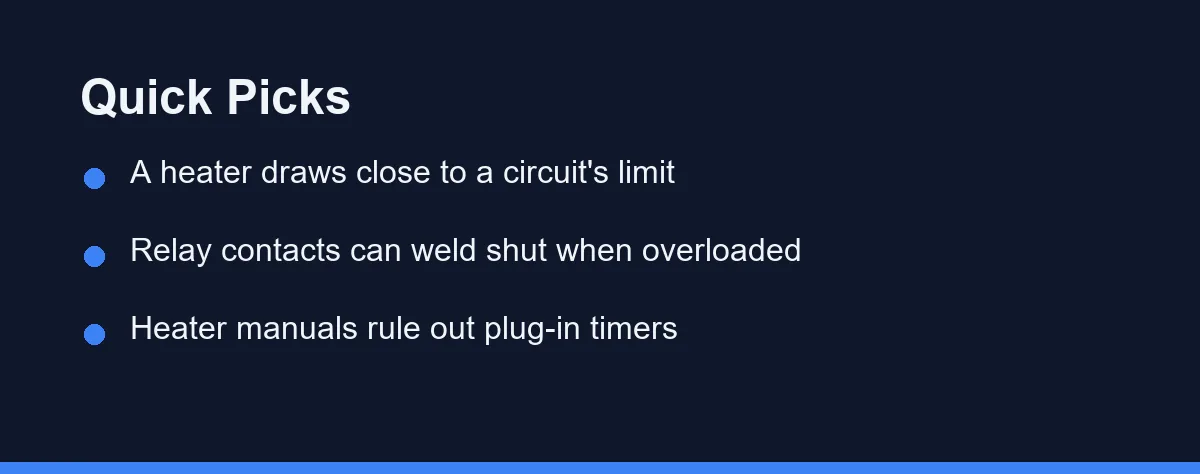
Do not put a portable space heater on a standard smart plug. Nearly every heater manual rules out plug-in timers, adapters and extension cords, and a smart plug is all three ideas combined.
The reason is heat rather than voltage. Running near a device’s maximum current for hours warms the contacts inside the plug, and the maker sized those contacts for lamps and fans.
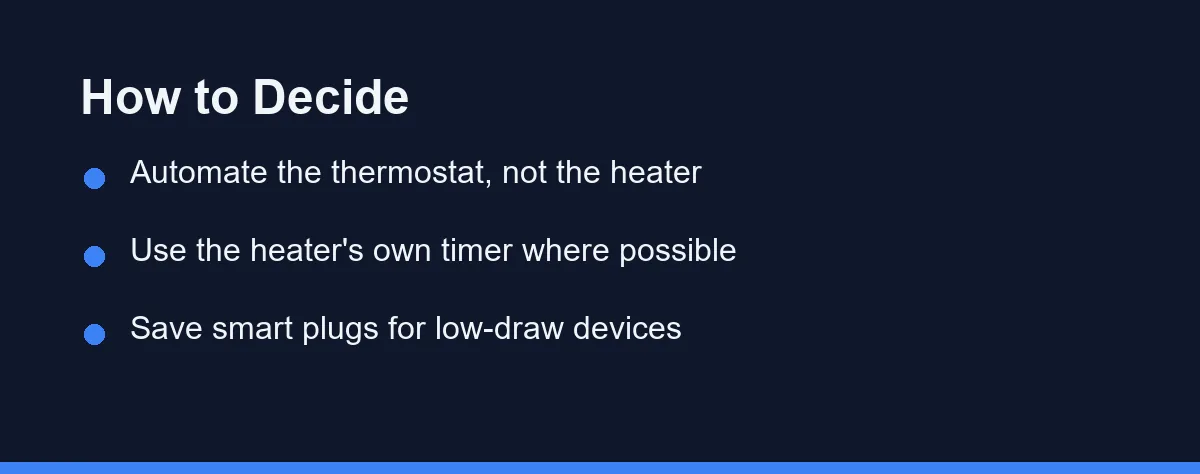
There are legitimate ways to automate heating, and they exist further up the chain. Control the thermostat, or use a heater that schedules itself, instead of interrupting the cord.
What the Numbers on the Label Mean
The arithmetic is simple, and it explains the whole problem. A common portable heater carries a 1,500-watt rating on its high setting.
On a 120-volt supply that works out at roughly 12.5 amps. A standard household branch circuit carries a 15-amp rating, so the heater alone claims most of it.
Electrical practice adds another constraint. A load running for three hours or more counts as continuous, and electrical practice caps continuous loads at 80 percent of the circuit rating, which is 1,440 watts on a 15-amp circuit.
That single number explains why a 1,500-watt heater already sits at the edge before anything else shares the circuit. Add a television, a laptop charger and a lamp on the same circuit, and the breaker is doing real work.
| Item | Typical draw | Share of a 15A circuit | Continuous-safe? |
|---|---|---|---|
| Space heater, high | 1,500 W | About 83 percent | No, exceeds 1,440 W |
| Space heater, low | 750 W | About 42 percent | Yes |
| Smart plug rated 10A | Limit 1,200 W | Below heater high | No |
| Smart plug rated 15A | Limit 1,800 W | Marginal for heaters | Not recommended |
| Table lamp with LED | Under 15 W | Under 1 percent | Yes |
| Box fan | 50 to 100 W | Under 6 percent | Yes |
The Failure Mode People Do Not Expect
A blown fuse would be the tidy outcome. The more common failure with an overloaded relay is quieter and worse.
Inside a smart plug sits a mechanical relay that physically closes a contact to complete the circuit. Sustained current heats those contacts, and heat plus arcing can weld them together.
Welded contacts mean the switch is stuck closed. The app still shows an off button, tapping it changes nothing, and the heater keeps running until someone pulls the plug from the wall.
The housing itself is the second concern. Cheap plugs are compact plastic boxes with limited ventilation, and the manufacturer’s rating assumes a switching duty rather than hours at full load.
What Heater Manuals Say, and Why
Open the safety page of almost any portable heater manual and the same instruction appears. Plug the heater directly into a wall outlet, and never use an extension cord, power strip, timer or outlet adapter.
That wording predates smart plugs, and the reasoning transfers exactly. Every one of those devices adds contacts and cable that were not part of the heater’s safety testing.
Fire statistics are the reason the language is so blunt. The NFPA reports that space heaters account for a large share of home heating fire deaths, and the full figures are published on their site.
Ignoring the instruction has consequences beyond safety. Home insurance claims and product warranties both hinge on whether the appliance was used as documented.
Ratings Are Not Interchangeable Between Regions
Plug standards differ, and so do the limits printed on the box. In North America, smart plugs are commonly rated 10 or 15 amps, and the 10-amp models cannot legally carry a full-power heater at all.
In the United Kingdom and much of Europe, sockets run at a higher voltage with 13-amp plugs, and heaters up to about 3,000 watts exist. The larger headroom is misleading, because the same relay heating problem applies.
Some plugs carry a separate, lower rating for resistive loads. Heaters, kettles and toasters are resistive, and that smaller number is the one that matters.
The practical rule is to read the plug’s own label rather than the marketing copy. Ratings on the retail page are frequently the optimistic figure, a mismatch also discussed in our best smart plugs guide.
The Risk That Has Nothing to Do With Wiring
Even a perfectly rated switch does not solve the real hazard of remote heating. Turning a heater on when nobody is in the room removes the person who would notice a problem.
Heaters need clearance on all sides, and rooms change during the day. A towel dropped over the unit, a curtain blown against it, or a cat that moved the heater are all invisible from an app.
Modern units include tip-over switches and overheat cutouts, and those protections are genuine. They act as a backstop for an attended appliance, not as permission to run one unsupervised.
Automation misfires add a further layer. A cloud outage, a duplicated schedule or a voice command misheard by a speaker can all switch a heater on at the wrong moment.
Safer Ways to Get the Same Result
The goal behind this question is usually warmth on a schedule, and there are clean ways to achieve it. Start by moving the automation to equipment designed for it.
A smart thermostat controls central heating through low-voltage wiring, so no relay handles the heating current at all. Our comparison of smart thermostats and programmable thermostats covers what each type can schedule.
Many heaters include their own timer and thermostat. Setting the unit to maintain a temperature is safer than cycling the power, since the heater manages its own startup and shutdown.
For a permanent solution, an electric wall heater or baseboard unit can be wired to a smart switch or thermostat by an electrician. That is a fixed appliance on a dedicated circuit, which is a different situation from a portable heater on a plug.
Where warmth is only needed briefly, a heated blanket or mattress pad draws a fraction of the power. Guidance on electrical safety at home from the ESFI is a useful cross-check before automating anything that produces heat.
Who Should Automate What Instead
The right answer depends on what you own and what you are trying to schedule.
Best for renters with portable heaters: No smart plug. Use the heater’s own thermostat and timer, and keep the unit plugged directly into the wall.
Best for homes with central heating: A smart thermostat. It schedules the whole house, uses low-voltage control wiring, and removes the portable heater from the routine entirely.
Best for a cold room that needs a fixed solution: A hardwired heater with a proper wall control. An electrician sizes the circuit, which is the only way to run heat continuously without stress.
Best for measuring what a heater costs to run: A meter rated for the load, used briefly and while you are present. Energy monitoring is a common motive, as explored in our do smart plugs save money guide.
Best for warming a bed before sleep: A heated blanket or pad on a timer. The draw is small, the appliance suits unattended use, and the comfort payoff is immediate.
Best for automation fans who want everything scheduled: Low-draw devices only. Lamps, fans, humidifiers and chargers all sit far below the limit, which is where smart plugs work as intended.
Mistakes That Turn a Small Idea Into a Hazard
The most frequent error is reading only the amp rating and assuming a match. A 15-amp plug and a 12.5-amp heater look compatible on paper, and that comparison ignores continuous duty entirely.
Stacking devices is the second mistake. A smart plug in an extension cord, or two heaters on one circuit, multiplies every risk the manual warns about.
People also assume a surge protector helps. Surge protection guards against voltage spikes, and it does nothing about sustained current or relay heating.
Testing briefly and concluding it is fine is another trap. Contacts degrade over months, so the failure typically arrives long after the test that seemed to prove safety.
Finally, many buyers trust the retail listing over the device label. Marketing copy quotes the best-case rating, while the label carries the resistive-load figure that applies to heaters.
The Load Decides, Not the App
Smart plugs are excellent at what they were built for, which is switching modest loads on a schedule. A space heater is a different category of appliance, and it pushes both the plug and the circuit toward their limits for hours at a time.
The safest version of this automation moves control away from the cord. A thermostat, a heater’s built-in timer, or a properly wired fixed unit all deliver scheduled warmth without a small relay carrying the load.
If you take only one number from this, make it 1,440 watts, the continuous limit on a standard 15-amp circuit. A 1,500-watt heater sits above it before anything else is plugged in.
For low-draw automation that works reliably, see our comparison of smart plugs and smart bulbs to decide which layer belongs in each room.
FAQ
Do space heater manufacturers allow smart plugs?
Most heater manuals say no. They instruct owners to plug the unit directly into a wall outlet and to avoid extension cords, power strips, adapters and plug-in timers, which includes smart plugs.
How many amps does a 1,500-watt space heater draw?
A typical portable heater on a 120-volt outlet draws about 12.5 amps at its high setting. That is close to the ceiling of a standard 15-amp circuit once the 80 percent continuous load rule is applied.
What happens if a smart plug is overloaded by a heater?
The relay inside can overheat and its contacts can weld together. When that happens the switch stays closed, so the heater keeps running and the app can no longer turn it off.
Is there a safe way to automate heating?
Yes, and it is the safer path. Central heating controlled by a smart thermostat, or a heater with a built-in timer and thermostat, gives you scheduling without a relay in the current path.
Can I use a smart plug for other appliances in the same room?
Only for low-draw devices. Lamps, fans, chargers and small appliances sit far below the plug's limit, and that is the load smart plugs are designed to switch.
Sources
- ENERGY STAR: smart thermostats — checked 2026-09-08
Some links may be affiliate links. We may earn a commission at no extra cost to you.
This article was written with AI assistance. It is researched and fact-checked, not based on personal hands-on testing unless explicitly stated.

No comments:
Post a Comment