
Lamps and Fixtures Take Different Paths
Choose a smart plug for corded lamps and a smart switch for hardwired ceiling or wall fixtures. If you rent, plugs win because they leave no trace. Most homes end up with both, one device per kind of light.
Making the lights smart sounds like one decision, but it splits into two very different paths the moment you look at how your lights are actually wired. Some sit in lamps with a cord and a plug. Others hang from the ceiling and answer only to a switch on the wall.
That physical difference is the whole story. A smart plug and a smart switch both let you control lighting from a phone or a voice assistant, yet each one only fits a particular kind of light.
This guide sorts out which tool matches which light. It walks through what each device controls, where the wiring and the lease steer the choice, and how the per-light cost changes once you multiply the plan across a whole room.
Look at the Light Itself First

Look at the light itself first. If it is a lamp with a cord, a smart plug is the fast, no-wiring answer that pops into the outlet behind it. If it is a hardwired ceiling or wall fixture, a smart switch is the right tool because it replaces the control the fixture already uses.
Renting pushes you toward plugs, since they leave no trace. Owning a home with lots of ceiling lights makes switches the cleaner, more permanent solution. Most homes end up mixing both, one per kind of light.
Four Checks to Run Room by Room
Four checks separate the right pick from a frustrating one. Run each room through them before you order anything.
Lamp or hardwired. This is the deciding question. A plug only works for something with a cord, and a switch only works for a fixture wired into the wall. Get this wrong and the device simply cannot control the light.
The wiring in the box. Smart switches connect to mains wiring, and many need a neutral wire that older homes never ran to the switch. Checking for that neutral before you buy saves a return and a headache.
Manual control that survives. A smart switch keeps working by hand, so anyone can flip it normally. A plug can be cut off if someone switches the lamp itself off, which strands the plug with no power.
Whether you rent. A plug installs and removes with zero marks on the wall. A switch changes the wiring, which most leases discourage without permission.
Comparing the Two Devices
What a smart plug does for lighting
A smart plug sits between the wall outlet and a lamp’s cord. It cuts or restores power on a schedule, from an app, or by voice, which turns any ordinary lamp into a scheduled or remote-controlled one. Kasa by TP-Link, Wyze, and Amazon’s own plugs are common picks.
The strength is zero friction. There is no wiring, no tools, and no risk, since you are only plugging something in. It also moves with you, so a renter takes every plug at move-out.
The catch is the manual switch on the lamp. If someone turns the lamp off at its own knob, the plug loses power and the schedule stops until it is switched back on. For a broader look at where plugs shine, our best smart plugs roundup sorts the reliable models from the rest.
What a smart switch does for lighting
A smart switch replaces the wall switch entirely and takes over the hardwired fixture behind it. Because it controls the fixture at the source, it works for ceiling lights, wall sconces, and anything without a plug. Lutron Caseta, Kasa, and Leviton are well-known options.
The advantage is that it never breaks the normal way to use a light. The wall control still works by hand, so a guest who ignores the app flips the switch and the light responds. Many models add dimming for the whole fixture.
The cost is the install. It involves mains wiring inside the wall box, and a missing neutral wire can rule out certain models. A no-neutral line like parts of the Lutron Caseta range exists precisely for older homes.
How they compare to smart bulbs
There is a third path worth naming, because it changes the math. A smart bulb puts the intelligence in the bulb itself and keeps the existing fixture, which suits a single lamp or a color-lighting fan.
The trade-off between screwing in smart bulbs and switching the whole circuit is a real fork. Our smart plugs versus smart bulbs comparison lays out when each makes sense, and it applies just as much when a switch is the third contender.
The Points That Decide a Lighting Project

The table stacks the two against the points that decide a lighting project. Read it with your own rooms in mind, fixture by fixture.
| Factor | Smart plug | Smart switch |
|---|---|---|
| Works with | Lamps with a cord | Hardwired fixtures |
| Install | Plug into an outlet | Wire into the wall box |
| Wiring skill | None needed | Mains work, may need neutral |
| Manual control | Can be cut at the lamp | Always works by hand |
| Renter friendly | Very, leaves no trace | Rarely, alters wiring |
| Best for | Table and floor lamps | Ceiling and wall fixtures |
The divide is tidy once it is written out. Plugs own the lamp world, and switches own the hardwired world.
The overlap is small and mostly comes down to rooms that have both kinds of light. There, most people use one of each.
Dimming is one more line worth noting before you decide. A smart switch dims the whole fixture at the wall, which feels natural and works for anyone in the room. A plug only cuts power on or off, so soft dimming has to come from a smart bulb screwed into the lamp instead.
Per Unit, Per Pack, and the Dimming Premium
Costs vary by brand, dimming features, and whether a pack lowers the per-unit price, so treat these as rough guides. The figures below are approximate and accurate at the time of writing. Confirm current pricing on the official site before buying.
| Device | Approximate price | Notes |
|---|---|---|
| Basic smart plug | roughly $8 to $20 each | Cheaper in multi-packs |
| Outdoor or metering plug | roughly $15 to $35 each | Adds weatherproofing or usage data |
| Single smart switch | roughly $20 to $50 each | May need a neutral wire |
| Dimmer smart switch | roughly $30 to $70 each | Full-fixture dimming |
Smart plugs are cheap per unit and cheaper still in packs, which makes them easy to scatter across a few lamps. The low cost is a big part of why they are the usual starting point.
Smart switches cost more each and add install effort, but they cover an entire fixture that a plug cannot reach. Spread across many ceiling lights, the per-room total climbs, so plan by fixture rather than by whim. If lower power bills are part of the appeal, our look at whether smart plugs save money explains what to realistically expect.
Which Control Fits Each Light
The lamp-heavy living room: Table and floor lamps are the classic smart plug scenario. A pack of plugs schedules and voice-controls every lamp without touching the wiring. It is the fastest, cheapest way to automate a room full of cords.
The homeowner with ceiling lights: Hardwired fixtures need a smart switch, since there is no cord to plug. A Lutron Caseta or Kasa switch keeps the wall control working and adds dimming. For an older home, confirm the neutral wire or pick a no-neutral model.
The renter: Reversibility comes first, so plugs win almost every time. They leave the wiring and walls untouched and travel to the next place. Save the switches for a home you own or a landlord who signs off.
The shared household: Where several people use the lights, the dead-plug problem matters. A smart switch keeps the light working by hand for anyone who ignores the app. That reliability is worth the install in a busy family space.
The mixed-lighting room: A room with both lamps and a ceiling fixture calls for both tools. Put plugs on the lamps and a switch on the fixture, and control the whole room from one app. Matching each device to each light is the cleanest result.
Slip-Ups That Derail Lighting Projects
A few predictable slip-ups derail lighting projects. Each is easy to head off.
Do not buy a smart plug for a ceiling light. There is no cord to plug in, so the plug has nothing to control.
Do not order a smart switch without checking for a neutral wire. Many older boxes lack one, and only certain models work without it.
Do not forget the manual-switch trap with plugs. If a lamp gets switched off at its own knob, the plug goes dark until someone turns it back on.
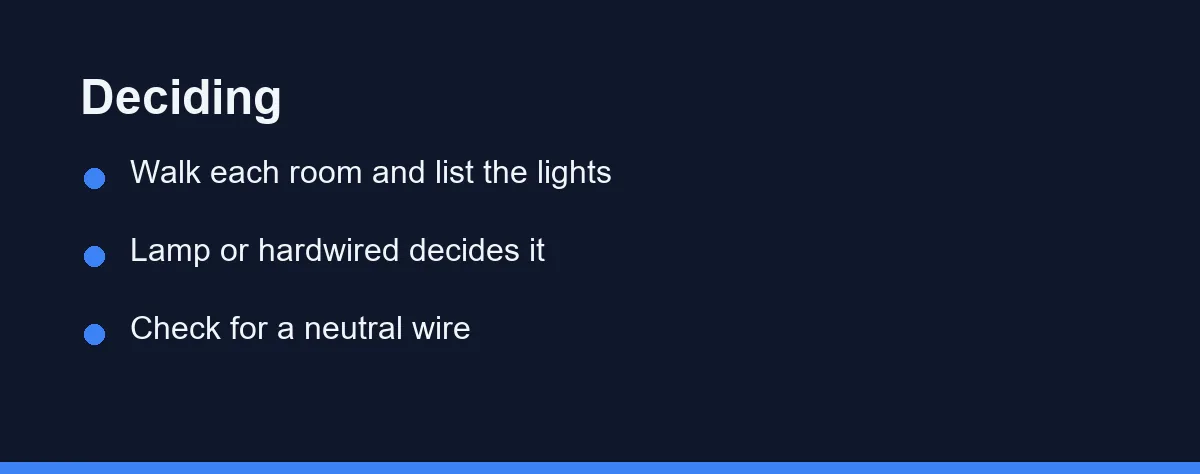
Do not plan by the device instead of by the light. Walk each room, list every fixture and lamp, and match the tool to each one.
Specialists, Not Rivals
Smart plugs and smart switches are not rivals so much as specialists. A plug owns lamps with cords, and a switch owns fixtures wired into the wall, and each is nearly useless in the other’s territory.
The right choice falls out of a quick walk through your rooms. Note which lights are lamps and which are hardwired, check for a neutral wire where a switch is needed, and factor in whether you rent. If that box turns out to have no neutral, what you can still automate without one covers the routes that remain.
Most homes land on a blend, one device per kind of light. Match each tool to the fixture in front of it, and the whole house answers to a single app without any of the guesswork.
FAQ
What is the real difference between a smart plug and a smart switch?
A smart plug controls whatever lamp is plugged into it, while a smart switch replaces the wall switch and controls the ceiling fixture wired to it. If your lights are lamps on tables, a plug is simpler. If they are hardwired ceiling or wall fixtures, a switch is the natural fit.
Do I need an electrician to install either one?
Not usually for a plug, since it just goes into an existing outlet with no wiring at all. A smart switch does involve mains wiring inside the wall box, and many older homes lack the neutral wire some switches need. If you are unsure about the wiring, an electrician is the safe route.
Can I make a ceiling light smart without a smart switch?
A smart switch is the better answer for a hardwired ceiling light. It replaces the existing wall switch and keeps the normal switch working for anyone who does not use the app. A plug cannot control a fixture that has no cord to plug in.
Which option is better for renters?
Renters generally lean toward smart plugs because they involve no wiring and leave no trace. A plug pops into an outlet and comes right back out at move-out. Smart switches alter the wall wiring, so most renters avoid them unless the landlord agrees.
What happens if someone uses the manual switch by mistake?
A smart switch keeps the wall control fully functional, so the light works normally by hand or by app. A smart plug can be bypassed if someone flips the lamp's own switch off, which cuts power to the plug. Choosing a switch avoids that dead-plug problem for shared spaces.
Sources
- ESFI: Home Electrical Safety — checked 2026-09-15
- ENERGY STAR Guide to Dimmable LED Lighting — checked 2026-09-15
Some links may be affiliate links. We may earn a commission at no extra cost to you.
This article was written with AI assistance. It is researched and fact-checked, not based on personal hands-on testing unless explicitly stated.

No comments:
Post a Comment