
The Number the Certification Actually Guarantees
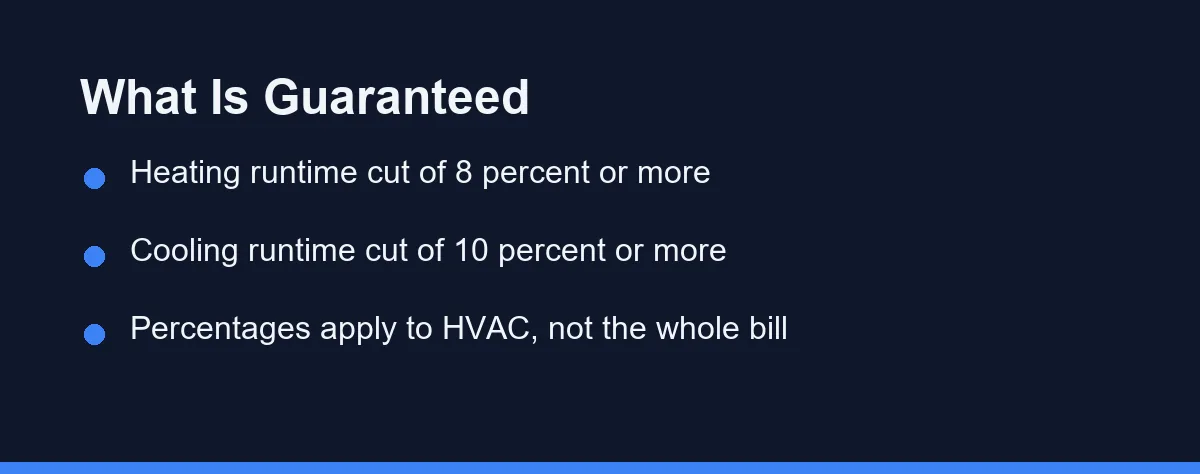
Expect a cut of roughly 8 percent on heating energy and 10 percent on cooling energy, not a cut to your whole bill. Those are the floors ENERGY STAR requires before it certifies a model, verified against a year of field data from hundreds of real homes. ENERGY STAR also reports that heating and cooling take almost half of the average American energy bill, more than $900 a year. Apply the percentages to that slice rather than the total and the honest annual saving lands in the tens of dollars for most households.
The rebate is often worth more than the first year of savings, which is why it deserves as much attention as the model you pick.
Where the $900 Figure Comes From
ENERGY STAR puts heating and cooling at almost half of an average household energy bill, more than $900 a year. That figure covers the furnace, the heat pump, and the air conditioner.
It does not cover your water heater, your refrigerator, your lighting, or anything else plugged into a wall. A thermostat has no influence over those loads at all.
So the arithmetic runs on the conditioning slice only. Cutting heating runtime by 8 percent on a home that spends $500 a year on heat returns about $40, and the cooling side works the same way.
Why Your Result Will Not Match the Advertised Figure
ENERGY STAR publishes two different savings numbers for each certified thermostat, and the gap between them explains most of the disappointment people report.
The first is a lower 95 percent confidence limit, described as similar to an average across the sampled homes. Certification requires at least 8 percent for heating and at least 10 percent for cooling on this measure.
The second is a 20th percentile figure, and the requirement drops to 4 percent for heating and 5 percent for cooling. ENERGY STAR explains this plainly: 4 out of 5 homes in the sample saved at least that much.
Read that second pair as the realistic floor for a household that already runs a sensible schedule. The average-style number belongs to homes that were leaving the heat on all day before.
The Rebate Routes and What Each One Asks of You

Rebates come from individual utilities rather than from ENERGY STAR, so the amount and the mechanics change by territory. The routes themselves are consistent, and knowing which one you are looking at saves a lot of confusion.
| Route | How the money reaches you | What it asks of you | What to verify first |
|---|---|---|---|
| Instant discount at checkout | Price drops at a participating retailer | Nothing beyond buying the listed model | That your exact model number is on the eligible list |
| Post-purchase rebate | Check or bill credit weeks later | Receipt, model number, account number, a form | The submission deadline after purchase date |
| Utility marketplace | Discount is already inside the shelf price | Buying through the utility storefront | Whether the marketplace price beats retail plus rebate |
| Demand response enrollment | Sign-up bonus plus annual credits | Letting the utility adjust the setpoint on peak days | The number of events per season and the opt-out rule |
| Income-qualified program | Thermostat supplied at low or no cost | Eligibility documents and often an installer visit | Which agency runs it in your state |
| Retailer promotion | Gift card or bundle discount | Timing the purchase to the sale | Whether it stacks with the utility rebate |
Start with the ENERGY STAR Rebate Finder, which takes a ZIP code and lists partner offers. Then open your own utility site, because the finder shows sponsored programs and does not always cover every provider.
What Demand Response Enrollment Really Trades
The enrollment route pays the most in many territories, and it is the one people sign up for without reading. The utility gains the ability to nudge your setpoint during a small number of peak demand periods.
ENERGY STAR requires certified thermostats to support these programs while keeping a consumer override, so you can push the temperature back. The trade is not control, it is attention, since overriding means noticing that an event is running.
Two numbers decide whether it suits you. How many events the program runs per season, and how far it moves the setpoint each time.
A household that is out all day rarely notices. A household with a newborn, a night shift sleeper, or a home office in a hot upstairs room may care a great deal, and cooling that upstairs bedroom is already the harder problem.
The Wiring Check That Decides Whether Any of This Applies
None of the savings arithmetic matters if the thermostat cannot power itself on your wall. Most models want a C wire, which supplies continuous low voltage rather than borrowing it from the heating call.
Pull the faceplate off and photograph the terminal block before you shop. Count the wires and note the lettered terminals, since that photo answers the compatibility question faster than any product page.
Missing the C wire is common in older homes and it is not fatal. Some thermostats include an adapter in the box, some brands sell one, and some installations need a new run, which is the case that can cost more than the rebate returns. Our guide to thermostats without a C wire covers the options in detail.
Five Requirements Behind the Logo That Marketing Skips
The certification is stricter than the badge suggests, and a few of the criteria are genuinely useful buying filters.
A certified thermostat has to keep working as a plain thermostat when connectivity drops. It has to show you your HVAC energy use rather than only a schedule screen. It has to hold temperature accuracy within 2.0 degrees Fahrenheit.
It also has to draw no more than 3.0 watts on average in network standby, and it has to support utility demand response with an override you control. The current specification took effect on January 1, 2017.
Those last two are the ones worth remembering. A thermostat that cannot join a demand response program cuts you out of the best paying rebate route in many territories.
Which Rebate Route Fits Your Household

The best route depends on your climate, your schedule, and how much paperwork you tolerate.
You want this done in one trip: Take the instant discount at a participating retailer. It pays less than enrollment in most territories, but nothing expires and nothing gets rejected for a missing receipt.
You run heavy air conditioning all summer: Demand response enrollment usually pays the most, because that is precisely the load the utility wants to shift. Check the event count before signing.
You are replacing a manual dial in a mild climate: The upgrade still pays, though the honest expectation sits near the 4 and 5 percent floors rather than the headline. Compare the models in our Nest and ecobee comparison before choosing.
You rent or expect to move within two years: Skip enrollment programs with multi-year commitments and keep the original thermostat in a labeled bag. The instant discount route leaves nothing to unwind.
Your household income qualifies for assistance: Look for the state weatherization or utility income-qualified program first. These often supply the device and the installation together, which removes the wiring risk entirely.
Mistakes That Cost People the Rebate
Buying the wrong model number is the most common. Eligible lists are specific down to the trailing letters, and a similar looking model from the same brand is frequently excluded.
Missing the submission window is the second. Post-purchase programs typically run on a deadline measured from the purchase date, and the receipt has to show that date clearly.
The third mistake is quieter. People enroll in demand response, get annoyed during the first heat wave, opt out of the program entirely, and forget that the annual credit stops with it.
The Order That Avoids Wasted Money
Photograph your wiring first. Everything else depends on whether the wall can power the device you want.
Next, look up the offers for your address, both on the ENERGY STAR Rebate Finder and on your own utility site. The eligible model list is the real shopping list, and it should shape the shortlist rather than the other way around.
Then set a realistic expectation. If the thermostat replaces a programmable model you already used well, the gain sits nearer the floor figures, which our comparison of smart and programmable thermostats walks through.
Full criteria and the rebate lookup live on the ENERGY STAR smart thermostat page, and utility program terms change every year, so confirm the current offer before you buy.
FAQ
How much does an ENERGY STAR smart thermostat actually save?
ENERGY STAR requires certified models to cut heating runtime by at least 8 percent and cooling runtime by at least 10 percent, measured against the homes in the field sample. Those percentages apply to heating and cooling energy, not to your whole electric bill, so the dollar figure depends on how much you spend on conditioning the house.
How do I find out what rebate my utility offers?
Start with the ENERGY STAR Rebate Finder and enter your ZIP code, then check your own utility website directly. Rebate programs are sponsored by individual utilities rather than by ENERGY STAR, so the finder shows partner offers but is not a complete list for every territory.
Can I claim a rebate and a demand response bonus for the same thermostat?
Usually not the full amount. Many utilities run two separate offers, one rebate for buying a qualifying thermostat and one enrollment incentive for joining a demand response program. Read whether the terms describe them as combinable, because some programs pay the enrollment bonus only to customers who did not take the purchase rebate.
Does a smart thermostat still work if the internet goes down?
Yes. ENERGY STAR requires certified thermostats to keep working as an ordinary thermostat when connectivity drops, so a router outage leaves you with manual control and your existing schedule rather than a blank wall plate.
What stops a smart thermostat from working with an older heating system?
The common blocker is a missing C wire, which supplies continuous power. Some thermostats ship with an adapter that solves it, and some systems need a new wire run. Confirm what your wall plate has before buying, because the fix can cost more than the rebate returns.
Sources
- ENERGY STAR: smart thermostats — checked 2026-09-08
- ENERGY STAR product finder — checked 2026-09-08
Some links may be affiliate links. We may earn a commission at no extra cost to you.
How this article was made: it was drafted with AI assistance from the official sources listed above, and its figures were checked against those pages on the dates shown. It is not based on personal hands-on testing.

No comments:
Post a Comment