
The Light Came On And The Manual Says Twelve Months
Air purifiers are sold on the sticker price and lived with on the filter price. The unit is a one-time cost, while the filters arrive every few months for as long as you own it.
Manufacturers quote intervals like six to twelve months. That number assumes a particular runtime, a particular room, and a household that does not own a shedding dog.
Most homes miss those assumptions in one direction or the other. Some people replace perfectly good filters early, and others run a clogged one for a year while wondering why the air still smells.
This guide separates the layers, explains what the filter light actually counts, and gives you the physical checks that beat any calendar. The aim is a schedule matched to your room instead of to a marketing figure.
Three Layers On Three Schedules
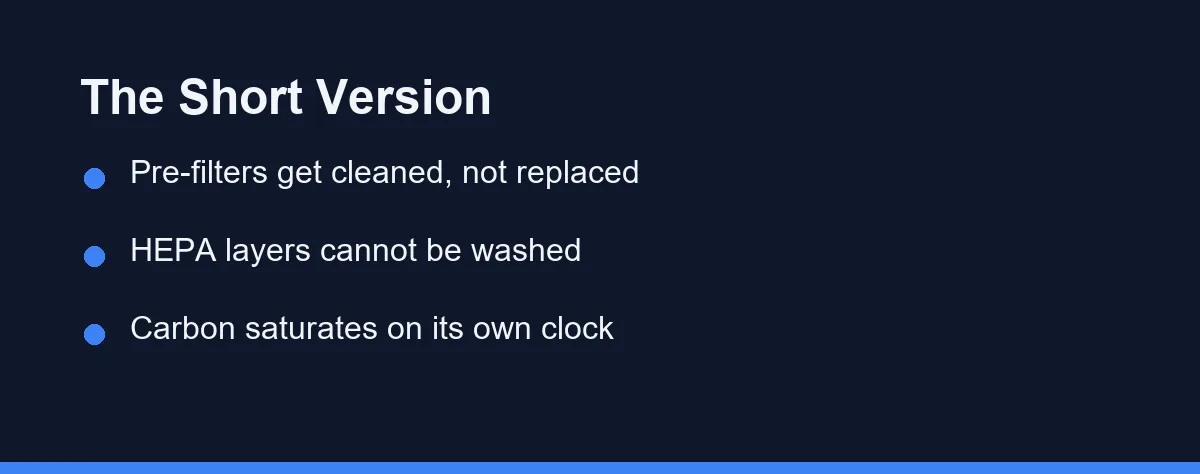
Nearly every purifier stacks the same three stages, and treating them as one unit is where the money goes wrong.
The pre-filter is a mesh or fabric screen that catches hair, lint, and large dust. Many are washable or vacuum-friendly, and this layer needs attention every two to four weeks.
The HEPA layer traps the fine particles that matter for allergies. It cannot be washed, since water separates the pleated fibres and destroys the capture efficiency permanently.
The activated carbon layer absorbs odours and gases rather than particles. It saturates on its own timetable, driven by cooking, pets, and smoke rather than by dust levels.
What The Filter Light Actually Measures
Almost every filter indicator is a runtime counter. It starts when you reset it, counts operating hours, and lights up at a preset threshold.
That has an obvious consequence. The light knows nothing about your air, so a unit running in a clean guest bedroom hits the same threshold as one beside a wood stove.
A small number of premium models pair the counter with a particle sensor and adjust the estimate. Even those measure the room rather than the filter itself.
Treat the light as a reminder to inspect. The physical checks in the next section tell you far more than the counter does, and they cost nothing.
What Each Layer Costs You In Time

The table compares the layers on the schedule each one actually needs, based on manufacturer guidance from brands including Levoit, Coway, Winix, and Blueair.
| Layer | Typical interval | Washable | What shortens it | Sign it is spent |
|---|---|---|---|---|
| Pre-filter | Clean every 2 to 4 weeks | Usually yes | Pet hair, carpet, open windows | Visible hair mat on the mesh |
| True HEPA | Replace every 6 to 12 months | Never | Smoke, construction dust, high runtime | Weak airflow, grey pleats |
| Activated carbon | Replace every 3 to 6 months | No | Cooking odours, pets, tobacco | Odours return between cleans |
| Combined HEPA and carbon | Replace every 6 to 12 months | No | Whichever layer saturates first | Either symptom above |
| Washable HEPA-style filter | Rinse every 1 to 3 months | Yes, by design | Humidity, incomplete drying | Musty smell after drying |
| Ioniser or UV stage | No filter to replace | Not applicable | Not applicable | Not applicable |
Read the fourth column before the second. Pets and smoke compress every interval in this table, and a home with both should assume the short end of each range.
Read the combined row carefully if you are still choosing a unit. Bundling the carbon and HEPA layers into one cartridge means paying for both whenever the carbon gives up first.
The Checks That Beat The Calendar
Hold your hand in front of the outlet at the highest fan speed and compare it to how it felt when new. Noticeably weaker airflow means the filter is restricting air, whatever the counter says.
Listen for the unit working harder. A purifier straining at the same setting it used to run quietly is pushing against a blocked filter.
Pull the filter out and look at the pleats in daylight. An even grey coating across the surface is the visual confirmation, and heavy discolouration on one side suggests poor placement rather than age.
Smell it. A musty note means the filter is holding damp debris, and that filter belongs in the bin regardless of how many months it has served.
Placement Changes The Schedule More Than Brand Does
Where the unit sits determines what it eats. A purifier against a wall behind a sofa pulls in far more settled dust than one with clear air on all sides.
Give the intake room to breathe. Most units draw air from the back or the sides, and blocking that face makes the fan work harder without cleaning more air.
Keep it away from the kitchen doorway if odours are your main concern, since cooking grease loads a carbon layer quickly. A unit two rooms away lasts longer and does less for the smell.
Close the windows while it runs. An open window feeds an endless supply of outdoor particles into a filter designed for a sealed room, and the filter pays for it. Our best air purifiers guide covers matching unit size to room size.
The Running Cost Nobody Budgets For
Filter prices vary by model and region, so check the current price of the replacement filter for your exact model before buying the unit itself.
The ratio matters more than the number. On many mid-range purifiers, a year of filters costs a meaningful fraction of the machine, and on cheap units it can approach the purchase price.
Multiply the filter price by the number of units in the house. Three purifiers on a six-month cycle is six filters a year, which is a different budget from the one the sticker suggested.
Check availability before you commit. Discontinued models leave owners hunting third-party filters of uncertain quality, and a brand that stocks filters for older units is worth a small premium.
Watch the electricity side too. A clogged filter makes the fan draw more power for less clean air, so late replacement costs money twice.
Mistakes That Waste Filters And Money
Vacuuming a HEPA filter to extend its life is the most common one. The suction pulls fibres apart, and the filter looks cleaner while capturing less.
Forgetting the pre-filter is the expensive habit. A clogged pre-filter dumps its load onto the HEPA layer, which shortens the life of the part that actually costs money.
Resetting the indicator without changing anything defeats the only tracking you have. If you reset it, note the date somewhere, because the counter is now measuring a fiction.
Running the unit on the lowest setting all day to save filter life rarely works out. Slow airflow means fewer air changes an hour, so the room stays dirtier while the filter ages anyway.
Buying unbranded third-party filters is the gamble. Some are fine and some use lower-grade media in an identical shell, and there is no way to tell from the listing.
Which Schedule Fits Your Home

The allergy sufferer in a carpeted bedroom: Vacuum the pre-filter every two weeks and plan on HEPA replacement at the short end of the range. Carpet is a continuous particle source.
The household with a shedding dog or cat: Clean the pre-filter weekly. Hair mats faster than anything else and is the single biggest cause of early HEPA failure. Our guide to the best robot vacuum for pet hair in a small apartment handles the floor half of the same problem.
The cook with an open-plan kitchen: Separate carbon layers are worth seeking out, since you will replace carbon two or three times per HEPA cycle. A combined cartridge doubles that cost.
The city flat beside a busy road: Assume the short end of every interval and keep windows shut while the unit runs. Traffic particles load a filter faster than indoor dust does.
The occasional user in a spare room: Go by the physical checks rather than the calendar. A unit running a few hours a week can genuinely last beyond the quoted interval.
The winter-only user fighting dry air and dust: Store the unit with a fresh filter rather than a spent one over summer, since a loaded filter sitting in a cupboard for months develops a smell. Our comparison of an air purifier versus a humidifier for winter allergies covers which machine to run first.
Inspect First, Then Replace
The honest answer to the timing question is that the quoted interval is a starting estimate, not a rule. Runtime, pets, cooking, and placement move it in both directions.
Build the habit around the pre-filter, since cleaning it monthly protects the layer that costs real money. Then check airflow and smell every couple of months and let those checks set the HEPA schedule.
Keep one spare filter in the cupboard for your main unit. Replacement usually gets delayed because the part has to be ordered, and a purifier running on a spent filter is an expensive fan. Confirm the current filter price and availability for your exact model on the manufacturer’s official site before your next purchase.
How fast a filter loads depends on what it was rated to catch in the first place. We compared the two rating systems in HEPA against MERV 13.
FAQ
What is the difference between the pre-filter and the HEPA filter?
The pre-filter catches hair and large dust and is often washable, so it needs cleaning every few weeks rather than replacing. The HEPA layer traps fine particles and cannot be washed without wrecking the fibre structure. Treat them as two separate maintenance jobs on two different schedules.
Can I wash a HEPA filter and put it back?
No. Rinsing a true HEPA filter swells and separates the pleated fibres, and it stops capturing fine particles even after it dries. Filters explicitly sold as washable use a different, coarser material and a lower efficiency rating.
My purifier's filter light came on early, does that mean it is clogged?
The timer counts running hours, so it has no way of knowing your air quality. A unit in a clean spare room may still have filter life left, while one in a smoky or pet-heavy room can be spent early. Use the timer as a prompt to inspect rather than as an instruction.
How do I tell a filter is spent without a filter light?
Weaker airflow at the same fan speed is the clearest sign, followed by the unit running louder to compensate. A musty smell means the filter is holding damp debris and should be replaced regardless of the timer. Visible grey coating on the pleats confirms it.
Do carbon filters need replacing more often than HEPA?
Carbon absorbs odours and gases rather than particles, and it saturates faster than HEPA traps dust. A combined filter forces you to replace both layers when only the carbon is finished, which is why separate layers usually cost less to run in a kitchen or a home with pets.
Some links may be affiliate links. We may earn a commission at no extra cost to you.
This article was written with AI assistance. It is researched and fact-checked, not based on personal hands-on testing unless explicitly stated.


No comments:
Post a Comment