
The Square Footage On The Box Is A Marketing Number
Shop on smoke CADR, and aim for roughly two thirds of your room’s floor area. A 300 square foot bedroom wants a figure near 200. If you are torn between two sizes, pick the larger one so it reaches that target on a quieter fan speed.
Most air purifier listings lead with a room size. Suitable for 1,500 square feet, says the headline, printed above a machine the size of a kitchen bin.
That figure usually assumes the unit runs flat out, in a sealed room, delivering a modest number of air changes. It is technically defensible and practically useless.
The number that survives scrutiny is CADR, short for clean air delivery rate. It is measured under a standard test and reported in cubic feet per minute.
Once you can convert CADR into air changes for your actual room, the marketing claim stops mattering. You get a target figure instead, and shopping becomes a matter of arithmetic.
The Short Answer On Sizing

Aim for a smoke CADR of roughly two thirds of your room’s floor area in square feet. A 300 square foot bedroom wants a figure near 200.
That ratio produces close to five air changes an hour with a standard eight foot ceiling, which is the level normally suggested for allergy households. General freshness needs less, perhaps half as much.
Buy one size up if the choice is close. The larger unit hits your target on a middle fan speed rather than its noisiest one, and that difference decides whether it stays switched on.
What CADR Actually Measures
CADR comes from a test run under the AHAM Verifide programme, which places a purifier in a sealed chamber and measures how fast it removes three particle types. The results appear as three numbers: smoke, dust, and pollen.
Smoke covers the smallest particles and is the toughest of the three, so it is the figure to shop on. Pollen is the easiest and usually the highest, which is why it tends to appear in advertising.
A CADR of 200 means the unit delivers clean air at the rate of 200 cubic feet each minute. It is a rate, not a capacity, so it only becomes meaningful once you compare it with the volume of your room.
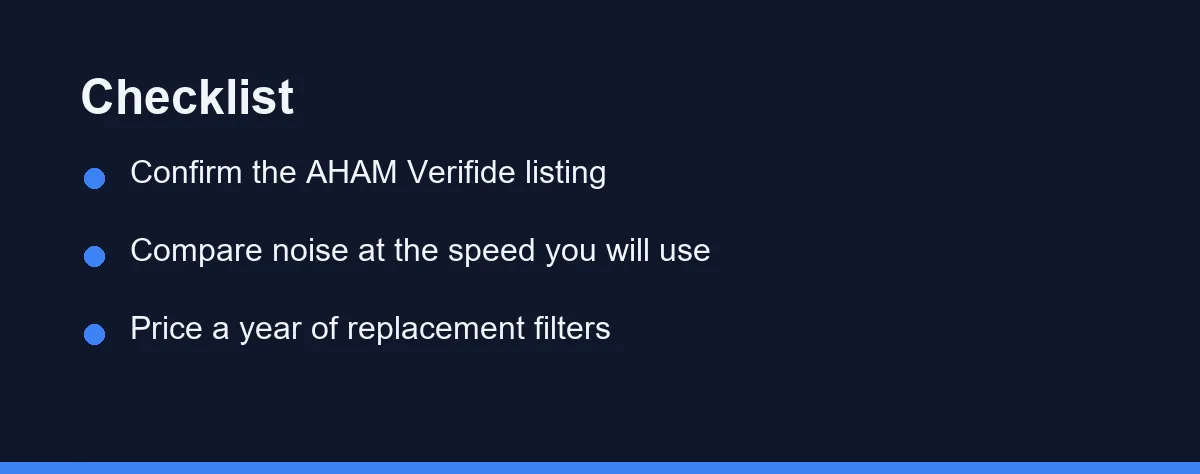
Verified figures can be checked on the AHAM Verifide directory, which lists models that have been through the test. A model with no listing is not necessarily bad, but its claimed coverage has not been independently measured.
Air Changes Per Hour Is The Figure Underneath The Rule
Air changes per hour, usually shortened to ACH, counts how many times a purifier processes a volume of air equal to the room in one hour. Four ACH means the equivalent of the whole room’s air passes through the filter four times.
The conversion is straightforward for a standard eight foot ceiling. Multiply your floor area by the ACH target, then multiply by 0.13 to get the CADR you need.
Two ACH suits general dust and cooking odours in a household with no particular sensitivity. Four to five is the usual recommendation where allergies, asthma, or pets are involved, and it is the range most sizing charts quietly assume.
Higher targets exist for wildfire smoke and renovation dust. Those are short-term situations where running a unit at full speed for a few days makes sense, rather than a reason to buy differently.
CADR Targets By Room Size

The table assumes an eight foot ceiling and shows the smoke CADR needed to reach each air change target. Round up when your room sits between two rows.
| Room size | CADR for 2 ACH | CADR for 4 ACH | CADR for 5 ACH | Typical use |
|---|---|---|---|---|
| 150 sq ft | 40 | 80 | 100 | Small bedroom, home office |
| 250 sq ft | 67 | 133 | 167 | Standard bedroom |
| 300 sq ft | 80 | 160 | 200 | Large bedroom, nursery |
| 400 sq ft | 107 | 213 | 267 | Living room in a flat |
| 500 sq ft | 133 | 267 | 333 | Open plan living area |
| 700 sq ft | 187 | 373 | 467 | Large open plan space |
| 1,000 sq ft | 267 | 533 | 667 | Usually needs two units |
The bottom row explains something the marketing rarely admits. Very few single units reach a smoke CADR beyond the mid hundreds, so large open spaces are a two machine problem rather than a one machine problem.
Note also that the AHAM programme caps its reported figures near the top of the scale. Two powerful units can therefore list identical numbers, and the tie gets broken on noise, filter cost, and physical size.
Where The Arithmetic Slips In A Real House
Ceiling height is the first correction. A ten foot ceiling adds a quarter to the room volume, so add a quarter to your CADR target before shopping.
Open doorways are the second. Air moves between connected spaces, and a purifier sized for a bedroom will underperform if the door stays open onto a hallway all night.
Leaky rooms are the third. Older windows and constant door traffic bring outdoor particles back in, which pushes the effective air change rate below the calculated one.
None of these ruin the method. They explain why the two thirds rule is deliberately generous, and why buying at the top of your bracket beats buying at the bottom.
Which Sizing Approach Fits Your Room
A bedroom used by someone with allergies: size for five ACH and run the unit overnight. This is the room where the extra capacity earns its money, since you spend a third of your life in it.
A living room with a pet: size for four ACH and expect frequent pre-filter cleaning. Hair blocks the first stage long before the HEPA layer wears out.
A home office used during the day: four ACH is plenty, but weight the choice toward the quietest model at mid speed. Fan noise during calls is the reason these units get switched off.
An open plan kitchen and living space: treat it as two rooms and consider two smaller units. Clean air does not turn corners well, and a single large machine leaves the far end untreated.
A nursery: size for five ACH, then check the noise rating at the speed you would actually run. A unit that reaches the target only on its loudest setting is the wrong unit for that room.
A rented flat with an open plan layout: size for the space you occupy most, not the total. A purifier in the bedroom outperforms one placed hopefully in the middle of the floorplan.
Buying Bigger And Running It Slower
The strongest argument for oversizing has nothing to do with air quality targets. It is noise.
A unit rated for 500 square feet, running in a 250 square foot bedroom, reaches your air change target on its lowest or middle setting. The same target in a smaller unit demands its highest speed, which is where the fan becomes intrusive. For scale, the EPA notes that a noise rating around 50 dB is roughly the operating noise of a modern refrigerator.
Power draw follows the same pattern. Fan energy rises steeply with speed, so the larger machine on low can consume less than the small one straining at maximum.
The tradeoffs are purchase price, filter price, and floor space. Oversizing by roughly a third is the point where most households stop gaining, which is the same logic behind sizing any always-on appliance, as our roundup of air purifiers works through in more detail.
Filters, Noise, And The Cost After The Receipt
A true HEPA filter captures the large majority of fine particles at the size that penetrates deepest, and the specification is defined rather than marketed. Terms such as HEPA-type or HEPA-like carry no such definition.
Replacement intervals depend on air quality and runtime, not on the calendar alone. A unit in a pet household will need attention sooner than the manual suggests.
Activated carbon is a separate stage for odours and gases, and it saturates faster than the particle filter. Households buying mainly for cooking smells should check whether the carbon layer is a thin coating or a genuine bed.
Price a year of filters before buying, since replacements often cost a meaningful fraction of the machine. Confirm current figures on the manufacturer’s own site as of 2026.
For the wider picture, the EPA’s guide to air cleaners in the home sets out what filtration can and cannot fix. Source control and ventilation still do work no filter can do.
What To Confirm Before You Buy
Measure the room rather than trusting the floorplan, then multiply by your ACH target and 0.13. Write that CADR figure down and shop against it.
Check the smoke CADR specifically, and check the model appears in the AHAM listing. A claimed coverage area with no CADR behind it is a claim, not a measurement.
Look at the noise rating at the speed that meets your target, not at the lowest setting the brochure quotes. Then price twelve months of filters and add it to the purchase cost.
Finally, decide where the unit will sit before it arrives. A purifier pushed into a corner behind furniture cannot pull air through itself properly, and no amount of CADR fixes a blocked intake.
Sizing decides how much air a unit moves, not what the media actually catches. For that half of the decision, see HEPA against MERV 13.
Placement then decides how much of that rated CADR reaches the bed rather than a wall. Where to put an air purifier in a bedroom compares the positions worth using against the ones that waste output.
Sizing also settles the question people ask next, which is how many units a home actually needs. Our comparison of one purifier per room against one that moves covers when a single correctly sized machine is enough.
FAQ
What CADR do you need for a 300 square foot room?
For a 300 square foot room with a standard eight foot ceiling, aim for a smoke CADR near 200 cubic feet per minute. That lands close to five air changes an hour, which is the level usually suggested for allergy relief. A figure near 160 still works if the room is used lightly.
Is a bigger air purifier always better?
Bigger is generally safer, because a large unit reaches the same clean air rate at a lower fan speed and therefore runs quieter. The limits are price, filter cost, and floor space. Oversizing by roughly a third is a common compromise.
How many air changes per hour do you need for allergies?
Four to five air changes an hour is the range usually cited for allergy and asthma households, against two for general freshness. The higher figure is why sizing charts ask for more capacity than the room technically needs.
Can one air purifier handle a whole house?
Rarely. Clean air does not travel well through doorways and hallways, so a single unit mostly treats the room it sits in. Households that care about air quality usually place one unit in the bedroom first and add a second in the main living space.
Do air purifiers with washable filters save money?
They save on replacements but only handle larger particles, since a washable pre-filter is not a substitute for the HEPA stage behind it. Treat washable layers as maintenance that extends the life of the real filter rather than as a way to avoid buying one.
Sources
- AHAM Verifide (CADR program) — checked 2026-09-08
- EPA: Guide to Air Cleaners in the Home — checked 2026-09-08
Some links may be affiliate links. We may earn a commission at no extra cost to you.
This article was written with AI assistance. It is researched and fact-checked, not based on personal hands-on testing unless explicitly stated.

No comments:
Post a Comment